
Why Has Southern China Become the“Second Battlefield”
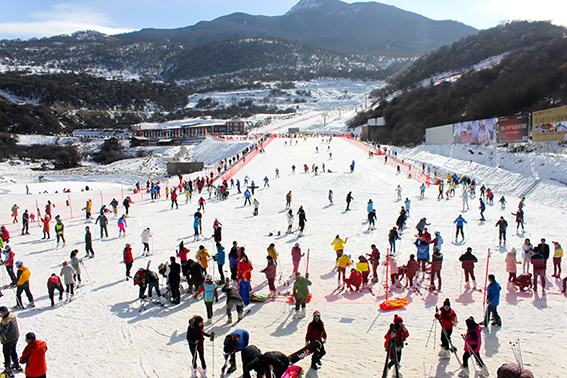
The recently concluded Milan Winter Olympics once again turned public attention toward winter sports. In 2025, China’s ice and snow economy surpassed the trillion-yuan mark for the first time. Beyond the naturally snow-rich northern regions, the “ice and snow boom” has swept across southern China as more indoor ski resorts open there, allowing winter sports to transcend geographical boundaries. Cities that rarely, if ever, see snow are now becoming new engines driving the growth of the ice and snow consumer market.
China's Ice and Snow Economy Surpasses One Trillion Yuan for the First Time
So, how large is China’s ice and snow economy today?
China’s ice and snow industry expanded from RMB 270 billion in 2015 to over RMB 1 trillion in 2025, achieving nearly fourfold growth within a decade. Nationwide, there are now more than 14,000 ice-and-snow-related tourism enterprises, representing an annual growth rate of 11%.
In fact, China’s “ice and snow fever” was already ignited around the time of the Beijing Winter Olympics in 2022. At that time, the government introduced the goal of “engaging 300 million people in ice and snow sports,” greatly stimulating public enthusiasm for winter activities.
Even after the Beijing Winter Olympics ended, the ice and snow economy has continued to gain momentum. During the 2025–2026 winter season, the number of ice-and-snow tourism visits nationwide is expected to reach 360 million.
Behind the rapid development of the ice and snow economy is the government’s continuous policy support. Multiple policy documents have laid out a clear blueprint for the sector. For example, in 2024, the General Office of the State Council issued the “Opinions on Stimulating the Vitality of the Ice and Snow Economy through the High-Quality Development of Ice and Snow Sports” (hereinafter referred to as the “Opinions”), aiming to consolidate and expand the achievements of getting “300 million people involved in ice and snow activities.”
Notably, in recent years China’s ice and snow economy has broken through geographical limitations. Southern China’s ice and snow economy is now experiencing explosive growth, becoming the “second battlefield” of China’s winter economy.
Indoor ski resorts are appearing one after another, and snow parks are packed with visitors. Winter sports, once difficult for many southern consumers to access, are increasingly becoming part of daily life, evolving into fashionable and entertaining leisure options. Most indoor ski resorts in southern China quickly became hugely popular after opening, rapidly establishing stable visitor traffic and demonstrating enormous market potential.
Why Can Ice and Snow Sports Thrive in Southern China?
Although most southern regions rarely see snow, they have still managed to create thriving snow and ice industries for several reasons.
The rarity of snow itself is the biggest selling point. Many southern residents have long dreamed of seeing and playing in snow and are willing to pay for this novel experience. In addition, southern China enjoys strong economic development and high consumer spending power.
For consumers, winter sports belong to the “happiness economy,” offering higher-quality and upgraded products and services that satisfy people’s pursuit of a better lifestyle.
So how can southern regions without natural snowfall “create snow out of nothing” and fulfill people’s longing for snow experiences?
First, the issue of “where the snow comes from” must be solved. Snowmaking technology in southern indoor ski resorts has become highly advanced, enabling people to ski on realistic powder snow indoors. Once the snow is created, sub-zero temperatures must be constantly maintained, resulting in extremely high air-conditioning and cooling costs.
Technological innovation has become the key breakthrough for southern ice and snow venues. For example, Shenzhen Huafa Ice and Snow World uses the building itself to generate photovoltaic power, meeting 20% of the resort’s annual electricity demand. This not only reduces energy consumption and emissions but also lowers operational costs.
Secondly, the ice and snow industry requires not only high technological barriers but also substantial capital investment and strong manufacturing capabilities — areas where Guangdong Province holds significant advantages.
Guangdong has firmly embraced this wave of growth in the ice and snow economy. The province now has more than 30 ice and snow venues welcoming visitors, while nearly 23,000 ice-and-snow-equipment-related enterprises are rushing to fulfill orders. Guangdong produces about one quarter of China’s ski equipment, from skis and ski apparel to snowmaking machines, with “Made in Guangdong” products being sold worldwide and fully leveraging the province’s manufacturing strengths.
Geographically, the “Greater Bay Area One-Hour Ice and Snow Economic Circle” has also attracted many visitors from Hong Kong and Macau. For example, at Guangzhou Sunac Snow World, visitors from Hong Kong and Macau accounted for 32% of total visitors in 2024. Guangdong’s ice and snow industry continues to grow rapidly.
A New Path for the Expansion of China’s Ice and Snow Economy
One major advantage of developing the ice and snow economy in southern China is the ability to create “tropical snow kingdom” style all-season winter consumption scenarios that operate year-round without seasonal limitations.
By transforming ice and snow experiences into stable and continuous consumer demand, these projects not only stimulate local consumption but also provide a new pathway for expanding China’s broader ice and snow economy.
In addition, the integration of winter sports with technology, culture, tourism, and sporting events has created entirely new consumer scenarios. Beyond traditional skiing and skating, “Ice and Snow Plus” integrated business models now offer one-stop, high-quality leisure experiences such as “Ice and Snow + VR,” “Ice and Snow + Intangible Cultural Heritage,” and “Ice and Snow + Hot Springs.”
Local governments have also tailored development strategies to their own strengths, creating distinctive approaches to developing the ice and snow economy. Through measures such as distributing consumer vouchers, developing premium tourism routes, organizing winter sports competitions, and hosting folk cultural events, regions have successfully ignited enthusiasm for winter consumption. “Cold ice and snow” has truly become a “hot economy,” serving as an important engine for regional economic transformation and consumer upgrading.
From “longing for snow” to “enjoying snow,” the growing integration between southern residents and winter activities reflects the vitality and potential of upgraded cultural and tourism consumption. Snow-covered landscapes are no longer exclusive to northern China — they are becoming a beautiful sight visible throughout all four seasons in the south as well.
source: sina.com